
It may come as a surprise that in Panama, a country renowned for its biodiversity, the most lauded animal of all isn’t the jaguar, the tapir, or the macaw, but a small, golden frog. Panama’s unique geographic positioning, between North and South America, and the Atlantic and Pacific Oceans, allows a diverse range of endemic and migrating creatures to flourish. And yet it’s the tiny golden frog, having been considered a symbol of good luck to pre-Columbian Indigenous communities, that has delighted Panamanians for centuries. In fact, there’s even a National Golden Frog Day — August 14th — to promote conservation efforts.
The Panamanian Golden Frog is the national animal of Panama, an amphibian native to the rainforests and cloud forests, and a significant symbolic figure representing both Panama’s cultural heritage and its biodiversity. The frog is so iconic as a symbol of Panama’s uniqueness, given its vivid coloration, representing the lush forest, and the waving behavior, which signifies the friendliness of its people. Though the endangered creature is extinct in the wild, there are still places in Panama where you can responsibly visit them today. Read on to find out where to spot them, as well as information about the natural history, cultural symbolism, and conservation challenges for Panama’s iconic golden frog.
The golden frog (Atelopus zeteki) is native to west-central Panama, within the Central Cordilleran rainforests and cloud forests. The frog was first discovered on the outskirts of the tiny town of El Valle de Antón and the Altos de Campana National Park. The frog is endemic to Panama, a country known for its high rate of endemism due to its range of over 100 microclimates, which create a habitable landscape for animals you can find nowhere else. The golden frog lives near moving water, amidst the fast-flowing, shallow streams and rivers of Panama’s jungles. Unlike other nocturnal amphibians, the golden frogs are daytime animals, and rather than merely croaking to communicate, they would wave their webbed feet at one another to send a message, like a form of amphibian semaphore — an evolutionary advancement caused by the fact that the rushing waters would drown out their croaking.
Their river habitat also impacted their mating rituals, too. The courtship process is more visual than simply auditory, as the males will twitch their heads and legs, hopping and stamping to attract a mate. They even wave to females, who will wave back if they like what they’re seeing. And when they do mate, the female frogs will produce up to 80 eggs in the shallow waters for the male to fertilize. The body of the frog is yellow with black spots on its back, often in the form of an ‘x’, and the frog’s vibrant color warns predators that it’s toxic — so, though the reptile may be small, it’s nevertheless mighty (the venom on the skin of a golden frog could kill up to thousands of mice). Though all adult Panamanian frogs are yellow gold with black markings (which are unique to each frog), when they are toadlets, their color variations can include green, orange, and red.
For reasons due partially to its unique behaviors as outlined above, the golden frog is regarded as especially significant culturally in Panama. For centuries, the frog has been viewed as a symbol of good luck — it was believed in pre-Columbian communities that seeing the golden frog brings fortune, and capturing one pretty much ensures a happy life. Its vivid, gold skin was also the stuff of legend, and many indigenous communities believed that whenever the frog died, its body would turn to gold (hence why they are such a symbol of prosperity). The frog was revered as a symbol of wealth and fortune — they were nature’s good luck charms, bestowing wealth upon anyone blessed enough to find one in the wild. They were also revered as a fertility symbol, and indigenous peoples would create guacas of the frogs — mud figurines they believed would turn to gold after they died, so they were buried alongside the dead to usher in good fortune in the afterlife. The frog was used in many crafts and artworks in indigenous cultures, and that permeates in Panama today — the golden frog is the name of not only jewelry and objects d’art, but also hotels, shops, stamps, and even alcohol (the Golden Frog is a microbrewery in Panama City).
Over the past few decades, the beloved golden frog has become extinct in its natural environment of central Panama, and the plight of the national animal has become a rallying cry for conservation. The last time a golden frog was spotted in the wild was in 2009, and one of the last recorded sightings was in 2006 for a David Attenborough BBC series, Life in Cold Blood, which documented the frog’s signature mating behavior (the waving technique) in its docuseries about amphibians and reptiles. The wild population of golden frogs had decreased over the years as a result of their cultural significance—people would collect the species to display in hotels and shops—but it wasn’t until the 1970s that the species was endangered. Studies have shown that the human population introduced an invasive fungus called Batrachochytrium dendrobatidis (Bd) to South America, which is fatal for many amphibians. The fungus transmits a disease, known as chytridiomycosis, that infects the frog’s skin, and was introduced in the 1970s and 1980s via the international amphibian trade, when cargo shipments of American bullfrogs, African clawed frogs, and other species carried the fungus without showing any symptoms.
Scientists are concerned that the sudden and rapid disappearance of many Central American frog species is an indicator of the Sixth Extinction, which some fear could destroy a quarter of the world’s mammals. This, of course, has massive consequences globally, and the rapid disappearance of the golden frog spurred national action in Panama. In 2010, Panama established August 14th as National Golden Frog Day and officially designated the amphibian as the country’s national symbol. The purpose of the day is to raise awareness about the conservation and preservation of the sacred creature.
Today, the only place in the world to spot the Panamanian golden frog is in El Valle de Anton, which is roughly two hours southwest (or 80 miles) from Panama City. The small town is along the Pacific Coast, in the shadow of the dormant volcano of El Valle, the world’s second-largest inhabited volcanic crater. There, you can visit the Golden Frog Sanctuary at the El Valle Amphibian Conservation Center (EVACC). This nonprofit organization oversees breeding facilities for the golden frog and eight other species of endangered amphibians, fostering scientific investigation to support long-term conservation goals, promoting sustainable community development, and raising awareness within Panama.
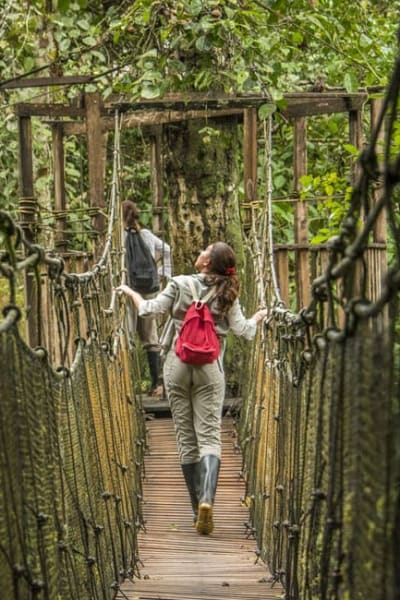
The sanctuary charges $3 per adult and $1 for children, and is open daily from 9 am to 4 pm except on Thursdays between May to December. This is the only spot in Panama to see the iconic frogs, and visitors have the chance to learn about the history of the frog from the guides and conservationists who know it best. Consider arriving early to walk along the suspension bridge and enjoy sweeping views of the tropical rainforest from the lookout of the Square Trees Nature Trail ($4 per person to access). Within EVACC, the frogs are housed in what’s called a ‘frog pod,’ a bio-secure cargo container with glassed walls for safe viewing and protection. Butterflies, birds, and — of course — golden frogs await.
While Rainforest Cruises aim to provide accurate and up-to-date information, we make no representations as to the accuracy or completeness of any information herein or found by following any link on this site. Rainforest Cruises cannot and will not accept responsibility for any omissions or inaccuracies, or for any consequences arising therefrom, including any losses, injuries, or damages resulting from the display or use of this information.