Bolivia Amazon Tours
The Bolivian Amazon lies more than a thousand kilometres from the mainstream of the mighty River Amazon itself and occupies a fraction of the total basin, and yet is still an excellent place to take an Amazon jungle tour, such as a riverboat cruise.
About a third of Bolivia lies within the Amazon basin, a vast, sparsely populated and largely untamed lowland region of swamp, savannah and tropical rainforest (known as selva).
Generally less developed than other parts of the Amazon – and consequently boasting a well-preserved natural environment – this is one of the most bio-diverse regions in the world, and though in recent decades the rate of forest destruction has accelerated to worrying levels, large areas remain relatively untouched and virtually unexplored.
Here, jaguars, tapirs and giant anteaters roam beneath the towering forest canopy and the skies are filled by a kaleidoscopic variety of birds. Turtles and caimans bask in the sun on the banks of the mighty rivers, which support a great variety of fish, including the much-maligned piranha, as well as playful pink freshwater dolphins.
Amazon Riverboat Cruises in Bolivia
Reina de Enin ~ Budget Class
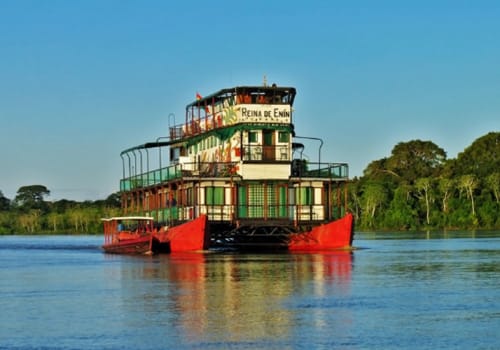
There is only one riverboat operating expeditionary cruises in the Bolivian Amazon, the Reina de Enín Amazon Riverboat or 'flotel'.
This is a traditionally-styled purpose-built riverboat, which voyages deep into the heart of the Bolivian Amazon rainforest, beginning in Trinidad and travelling along two rivers with different characteristics—the Río Ibare and the Río Mamoré—for a wonderful rainforest experience.
Although the facilities of the this riverboat are of a Comfort level, the price is positively Budget, owing to the generally lower cost of living in Bolivia.
Only 14 degrees south of the equator, Trinidad is a lively, tropical city (population 90,000) in north-central Bolivia and a starting point for great rainforest cruises and wildlife expeditions around the Mamoré River Basin. Situated 550 kilometers northwest of Santa Cruz on a paved road, Trinidad is the capital of the department of Beni, and de-facto capital of the Bolivian Amazon.
Trinidad lies in the headwaters region of the Amazon in northeastern Bolivia, 2,000 miles from both the river's source high in the Andes and its mouth at Belen, Brazil. But, unlike Iquitos in Peru, or other Amazonian towns in neighboring countries, ocean-going ships cannot venture upriver to Bolivia.
Founded as a Jesuit mission in 1686 under the name Santísima Trinidad, it was the second mission to be founded in the Moxos region, which is now part of the department of Beni. Its original position on the shores of the Río Mamoré proved too precarious, and it was moved to its current location in 1769, two years after the Jesuits were ejected from the region.
The 19th century brought wealth and prosperity to the region, firstly from the quina shrub, the base product of the malaria treatment Quinine, and then from rubber.
Sometimes overshadowed as a tourist destination by its Amazonian neighbor, Rurrenabaque, Trinidad's highlights revolve around its position in the heart of the Bolivian Amazon. The Río Ibare is just eight kilometers from town, and is the place to go for river trips, swimming in custom made pools on the riverbanks, fishing, walking or just relaxing.
The Río Mamoré, the biggest river in Bolivia, is also easily accessible from town, and is your ticket to pink river dolphins, abundant wildlife and huge sandy beaches. Trinidad is, therefore, the jumping-off point for an adventurous trip by slow boat down the Río Mamoré.
The city metropolis is surrounded by rivers, tropical forest and the vast, flat pampas. Trinidad itself has a welcoming, laidback vibe and daily life revolves around watching sloths in the central plaza, or sampling local ice-cream in one of the many street side stores. Fish is an obvious specialty and with cattle ranches on the town’s doorstep, prime steak is fresh and succulent.
Beyond Trinidad lies even less traveled waters. Wildlife sightings increase, preserved forest remains, and the native people still harbor a curiosity about visitors.
Climate is hot and humid all year round.
There are daily, domestic flights to Trinidad from La Paz, Cochabamba, and Santa Cruz.
Mamoré River
The mighty Mamoré – its name means 'Great Mother' in Moxeño – was once one of the great waterways of the Bolivian Amazon and still sees a good deal of traffic. Canoes, barges and double-decker river boats ply its silt-laden waters, carrying supplies to the isolated communities along the river bank, collecting cargoes of timber or bananas, and carrying cattle downstream to markets in Brazil.
Travelling the river by riverboat is one of the classic Amazon experiences, and an excellent way to get a feel for the immense scale of the forest and the lifestyle of its inhabitants. Every so often the dense vegetation of the river bank breaks to reveal a riverside settlement, usually no more than a cluster of thatched houses on stilts.
For the villagers, isolated in the midst of this immense wilderness, the arrival of a boat can be the main event of the day, and if yours stops to load or unload cargo it’s likely to be besieged by locals selling bananas or fish, or simply seeking the latest news and gossip from upriver.
Llanos de Moxos
Llanos de Moxos, meaning Moxos Plains, is the region around the Mamoré River which represents the southernmost extension of the Amazon Basin.
It is an immense hydrographic plain and a unique, expansive mosaic of different vegetation types including humid savannas bordered by a variety of forest communities that provide refuges for multitudes of wildlife.
Owing to the abundance and visibility of many wild animals, it is one of the best places in Bolivia to observe animals in their natural habitat.