
In the tiny shipbuilding village of Sangeang Wera, a Buginese settlement in northeast Sumbawa, the men build wooden boats along the scruffy shores, while the women weave brightly colored textiles. Today, something huge was happening in Sangeang Wera, and my partner and I had traveled there to watch it happen. On this auspicious day, when the king tide was expected to reach its peak at one o’clock in the afternoon, all eyes were on an enormous phinisi boat. After 18 months of handcrafted labor by four master boatbuilders, the ship was ready to be launched.
Fashioned from ironwood, 30 meters long with a 22-meter keel, 11 meters wide and weighing around 150 tonnes, this bulk carrier was the biggest boat ever to have been built in the village. She had been commissioned by six wealthy brothers from Java. The brothers and the builders were highly respected in the community and every member of the village was involved in an extraordinary manual operation to get the boat into the water. Vertical supporting beams had been positioned on either side of the vessel, logs had been laid perpendicular to the keel and planks had been laid parallel to form a slipway, which had been liberally smeared with thick, heavy engine grease.
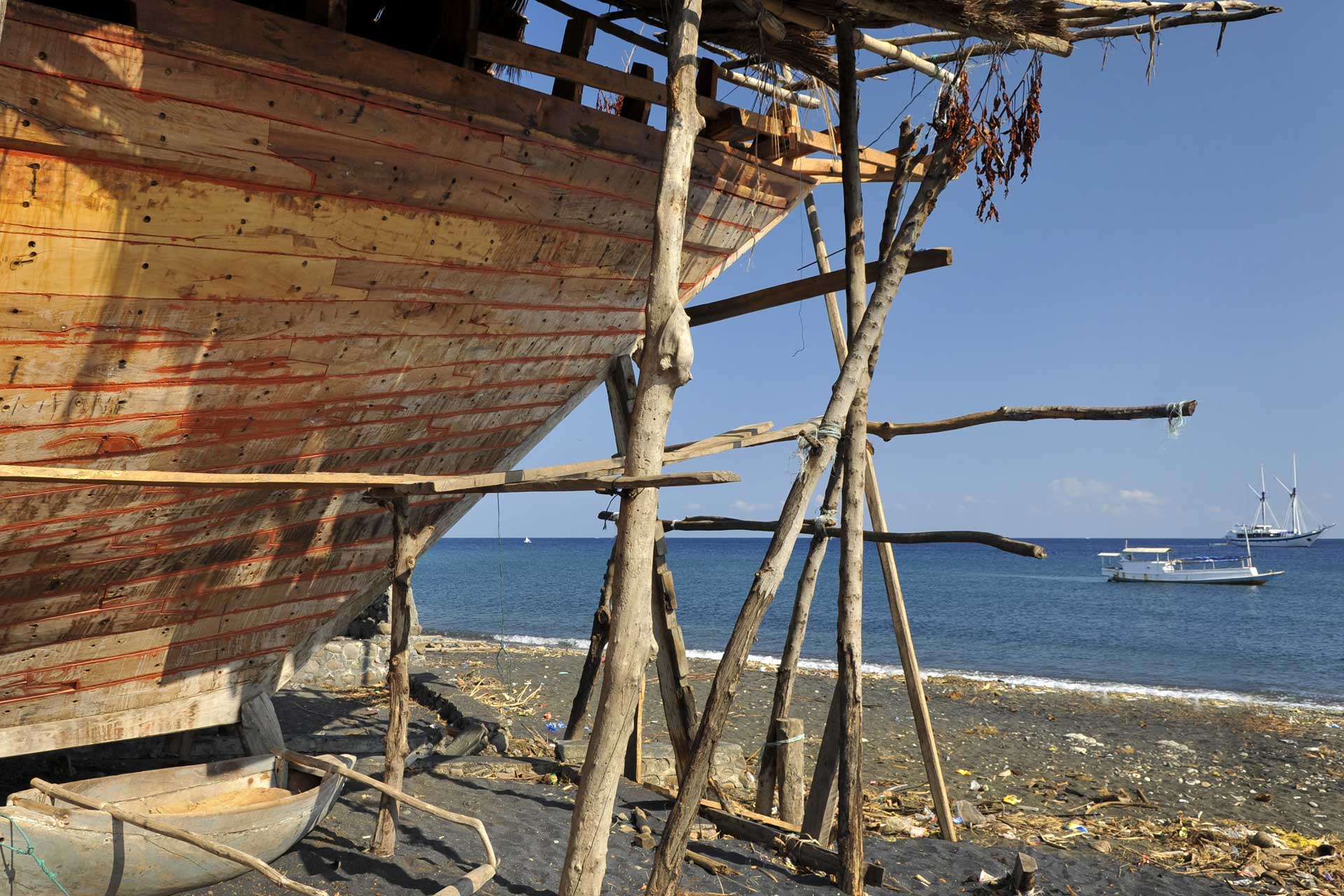
In Wera, the connection between land and sea is deeply spiritual. Traditional shipyards serve as the sacred setting for vital rituals and ceremonies that bless each phinisi hull long before it ever touches the water.
We’d arrived the previous day and had spoken to one of the builders who informed us, “We’ll start at sunrise tomorrow, and it will take three hours from the first pull until the boat reaches the water.” No one was getting paid, it was a collaboration, people were going to be literally pulling together to help one another. After dark, the men gathered on board, and we were invited to join them. Prayers were offered to Allah for a smooth launch and for the future safety of the vessel. In an earlier ceremony, a hole had been drilled at the midpoint of the keel, a crock of gold had been placed in the hole and the drillings were placed in a bottle of coconut oil. The gold is to protect the boat from harm, and the oil is used as a medicine to be rubbed on the keel should there ever be any trouble at sea.

Centuries of maritime history are carved into every plank. The traditional building techniques of the phinisi have been passed down through generations, preserving a master shipbuilding lineage that still thrives today.
Phinisi vessels, handcrafted by Bugis and Konjo shipwrights, are exceptionally strong and are famous for their ability to break through high waves and cover great distances. Some are built for the tourist industry and fitted out with luxury cabins and sundecks. Others are built as freight carriers for transporting cargoes such as rice, timber or cement. Amazingly, they are still built the traditional way, which is now classified as a UNESCO cultural heritage. The master boatbuilders do not have special engineering training. They don’t need architectural drawings or complicated technical calculations to determine the quantity of materials needed. Using a method that would be unworkable in mainstream shipbuilding, the builders first lay the keel; the stem and stern post are erected, and then the side planks are assembled before the ribs, without the need for a frame. Yet the builders can accurately establish the boat’s balance so it will float perfectly when launched into the water. “We just go with our instincts based on our vision and judgment,” the master builder told us, “our eyes and our feelings guide us when we’re building a boat.”

The historic shipyards of Sangeang Wera showcase the final stages of building a phinisi. Here, the impressive handcrafted hulls stand tall against the sky, waiting for the community-driven launch into the sea.
At sunrise the next day, I surveyed the scene on the beach; old and young, men, women and children, it was a frenzy of activity. Aft of the keel, winches had been prepared and 10 men on each side of the boat were tearing on the chains. A lengthy block of hardwood had been inserted under the base of the keel, with another line of men using it as a lever to rock the boat into position. A man on a megaphone, the ‘director of operations,’ was shouting orders. After a few minutes, the boat made its first move along the heavily greased slipway towards the sea; it was a tiny distance of less than a meter, but she was heading in the right direction. Out came a man with a chainsaw; a plank at the back end of the sled was cut away, and the procedure started again. Twenty minutes later, the boat moved another half-meter, and so it went on, slowly, slowly, each time to a resounding cheer. Suddenly there was an alarmingly loud bang, and a shout, and everyone leapt back. I could feel the communal dismay hanging heavily in the hot sultry air. The winch had broken and after a failed attempt to repair it, we were told that a new one must be brought over from the Island of Sangeang on the opposite shore.
A new winch was delivered, it was put into place and the process began again, the boat moved another meter. A tugboat then arrived to bring some engine power to the proceedings. All the boat needed now was one major pull to give it the momentum to slide the last 20 meters into the sea. A rope was attached. The tug moved into position. The engine strained. The rope broke. The exercise was repeated, while on either side of the phinisi, a gang of men, women and kids were hauling on two parallel ropes; it was like a massive tug of war, except that everyone was pulling and pushing in the same direction, with one common goal.
Finally, after several more failed attempts, the behemoth vessel started to slide, picking up speed and marvelously unstoppable, upright and perfectly balanced, faster and faster until she hit the water with a colossal splash and a mighty wave of triumph, before smoothly gliding to a buoyant halt, amid cheers and shouts of joy from the elated villagers on the shore.
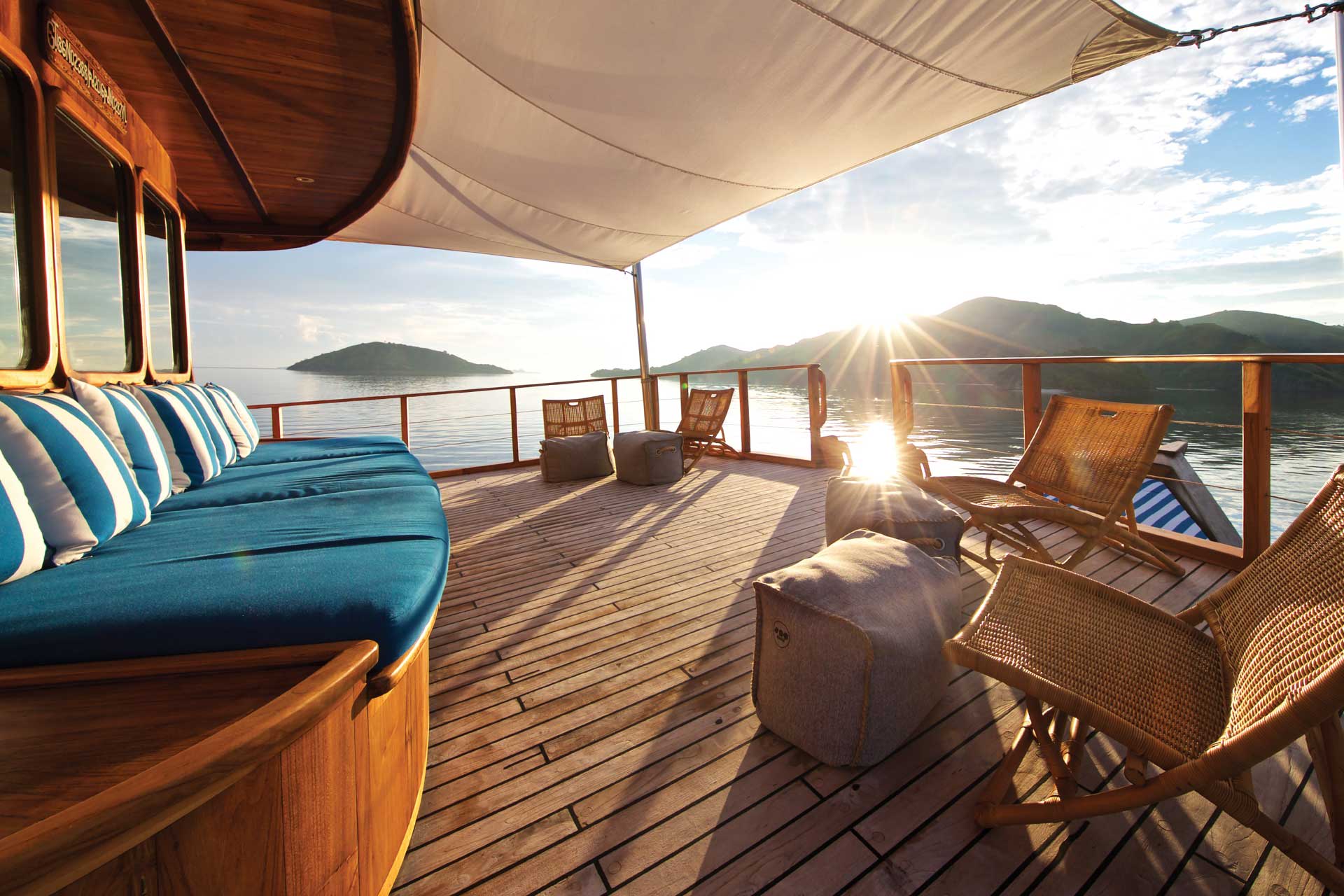
Stepping inside an Indonesia yacht charter phinisi reveals expansive outdoor decks crafted for relaxation. Shaded lounge areas provide the perfect vantage point for taking in pristine island panoramas at sunset.
Although this ship was built as a freight vessel, many phinisi boats are built – or converted − for modern-day expedition cruising. Beneath the polished decks of boats such as Silolona and Rascal, lies a hand-built hardwood hull. Thick ironwood ribs curve like the skeleton of a whale, supporting broad teak decks scented with salt, resin, and tropical heat. Stepping aboard one of these boats feels like entering a floating boutique hotel wrapped inside a traditional sailing ship. The experience begins at the stern, where guests usually board from small tenders after snorkeling, diving, or island excursions. Wet gear is rinsed here, fins and tanks are stacked neatly on dedicated dive decks, and crew members move between compressors, equipment stations, and storage lockers preparing for the next excursion.

The design of the cabins showcases how traditional woodworking meets modern comfort. Below deck, thoughtful layouts maximize space, seamlessly integrating the ship’s heritage with an upscale onboard experience. In the picture: Senja.
Inside the vessel, narrow polished stairways descend into the lower decks where guest cabins line timber corridors. Cabins are often surprisingly luxurious: king beds beneath carved wooden ceilings, brass reading lamps, air-conditioning, woven Indonesian textiles, ensuite bathrooms, and portholes just above the waterline.
Further aft is the engine room, the hidden mechanical heart of the phinisi. Here, powerful diesel engines, generators, and desalination systems operate continuously, allowing a centuries-old sailing design to function as a modern expedition yacht. The crew quarters are usually tucked discreetly below deck as compact, highly functional sleeping areas. Life for the crew is disciplined and communal, with long working days beginning before sunrise as they prepare tenders, navigate passages, cook meals, and maintain the vessel. The kitchen, known as the galley, is often one of the busiest spaces onboard. Despite surprisingly small dimensions, it’s here that the chefs produce delicious meals. Above the main deck sits the bridge, where the captain and navigation officers guide the phinisi through reefs, currents, narrow channels, and remote island chains. Traditional sailing heritage now sits beside modern radar, GPS systems, satellite communication equipment, and electronic charts.
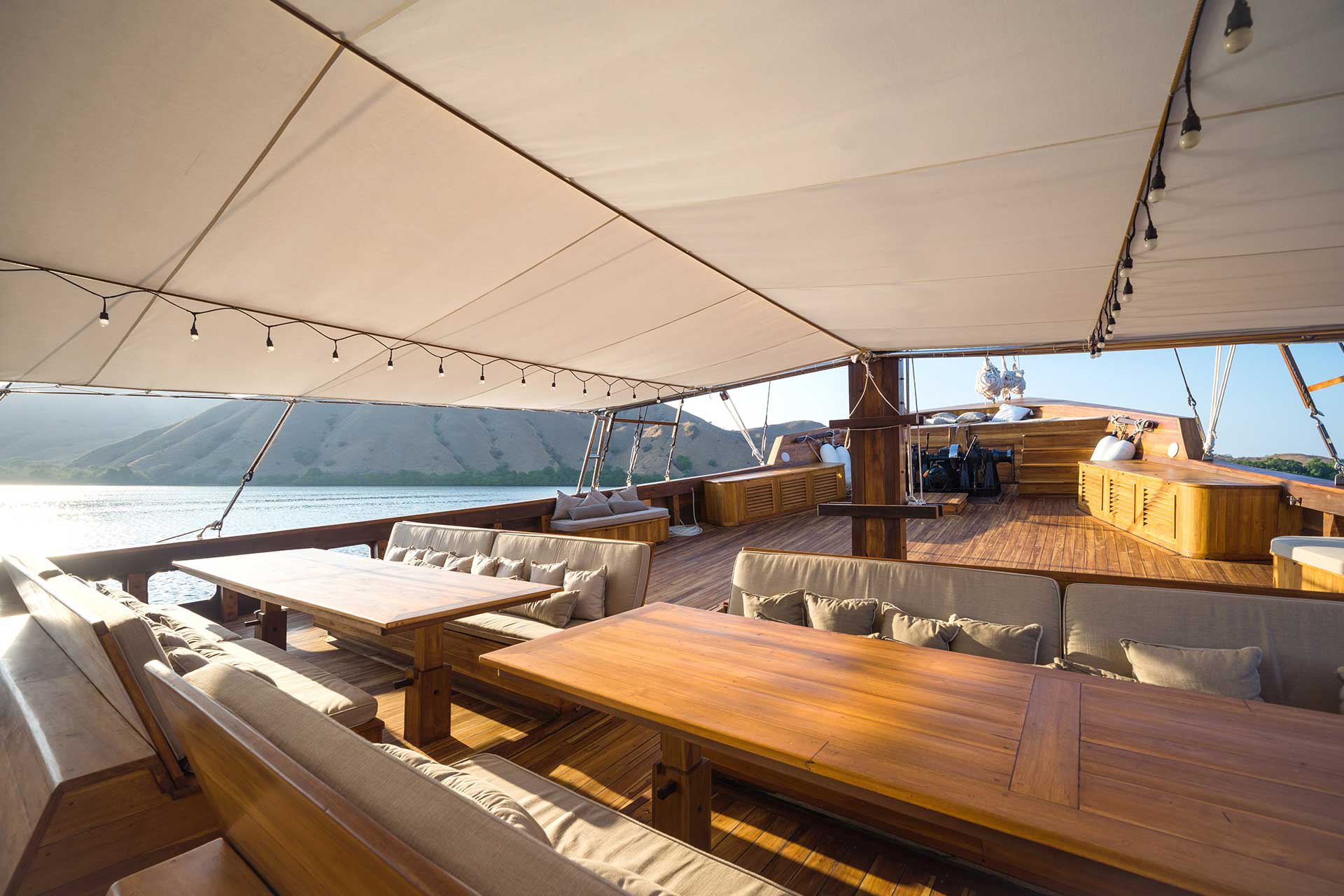
Designed for seamless relaxation, the expansive sundeck offers an ideal space for open-air dining. It exemplifies how modern Indonesian charters maximize onboard comfort without losing their classic sailing charm.
The social center of most phinisi cruise boats is the indoor salon. This multifunctional space is the living room of the expedition; a place for briefings, marine biology presentations, board games, and conversation during rainy weather or evening hours. Soft sofas, libraries, espresso machines, charging stations, and air-conditioning provide welcome comfort after long days in the sun.
Midships is often home to an outdoor covered dining area and lounging deck with shaded daybeds that become spaces for reading, or for watching flying fish skimming across the bow wave. Above this, rises the upper sundeck, the soul of the modern phinisi experience. Here, guests stretch out on loungers and beanbags, sunbathe during the day, or stargaze at night. Some boats include open-air bars serving cocktails at sunset while volcanic islands drift by in the fading light. On these gaff-rigged ketches, twin masts rise dramatically from the teak decks, rigged with thick ropes, wooden spars, pulleys, and traditional pin rails that still echo centuries of Bugis maritime craftsmanship. Although modern expedition phinisi yachts rely primarily on engines for precise navigation, the sails remain deeply important to the identity of the vessel.

As a living heritage, the phinisi continues to shape the soul of Indonesia’s waterways. Seeing these handcrafted vessels gathered in a quiet bay bridges centuries of maritime tradition with modern exploration.
Even with the addition of spa rooms and other lavish amenities, the ambiance of the phinisi remains unmistakably authentic. Timbers creak softly, while the boat rises and falls with the rhythm of the waves, connecting travelers back to the seafaring wisdoms passed through island communities for centuries.
While Rainforest Cruises aim to provide accurate and up-to-date information, we make no representations as to the accuracy or completeness of any information herein or found by following any link on this site. Rainforest Cruises cannot and will not accept responsibility for any omissions or inaccuracies, or for any consequences arising therefrom, including any losses, injuries, or damages resulting from the display or use of this information.