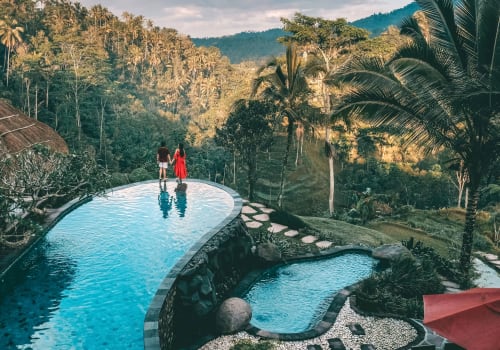

My friend Bella had asked for my advice. She was planning a solo trip to Indonesia but her research had left her feeling disillusioned. “Every resort, hotel and activity appears to be aimed at honeymooners, couples or families, and I’m expected to pay a single supplement for the privilege of staying on the outside of the experience. Why should I be punished for not traveling as part of a couple?”. Bella always traveled alone, but she claimed that her solo freedom came with a financial penalty. She told me that there’s a gap between backpacker hostels and high-end private villas, which solo travelers often fall through. “We’re overcharged for privacy and we’re under-served on companionship.”
My friend was also concerned that Indonesia would be a logistically exhausting country for traveling alone due to its many thousands of islands and unpredictable transport. I agreed that with a time constraint, this could definitely be a problem, recalling how my partner and I once had to spend five days in Ambon waiting for a public ferry to take us to the Banda Islands. Domestic flights often get canceled, while speedboats and extra overnight stays all add to the expense.
“Traveling independently through remote areas sounds adventurous until you realize you’re paying double for accommodation and arranging complicated transfers alone,” added Bella, “anyone who travels alone knows the frustration, and you can feel quite isolated after a while.”

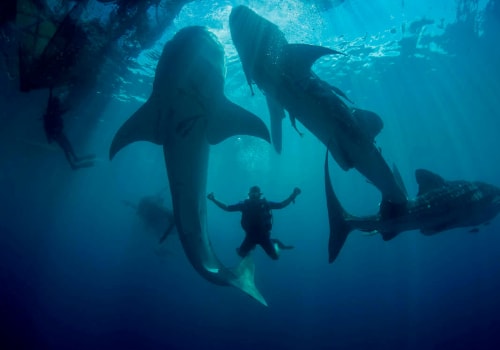
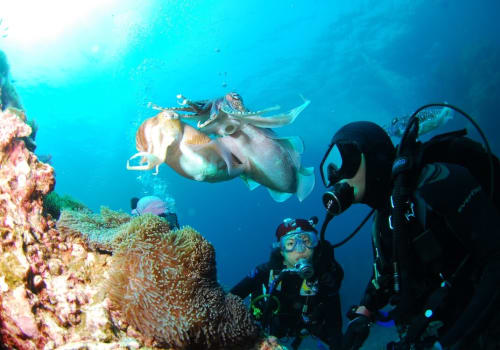
Diving straight into adventures from the deck changes everything. A small ship provides a seamless bridge between your onboard home and the vibrant marine worlds waiting just beneath the surface.
I proposed that she considered a sea voyage through Indonesia, but she dismissed my suggestion immediately, “You seriously think I’d enjoy being on a massive cruise ship with 6000 other passengers, 20 restaurants, three swimming pools, multiple jacuzzis, a theater, an ice rink, a water park, and a shopping arcade?”
Actually, no, I didn’t think that would be her preference, my friend is a rugged free spirit. Instead, I had a small-ship secret to share with her; a suggestion that would flip Indonesia from an intimidating sprawl into a beautifully contained adventure, in which the single supplement headache would become a solvable math problem instead of a brick wall.
“I’m not talking about the mega cruise version,” I explained, “I’m talking about the intimate Indonesian liveaboard boats − usually traditional wooden sailing ships − carrying 10 to 20 guests on dive trips and expedition cruises through places like Raja Ampat, Komodo, Alor, and the Banda Sea. The kind where you wake up anchored beside an uninhabited island, eat breakfast barefoot on the deck, and know everybody’s name by day two”.

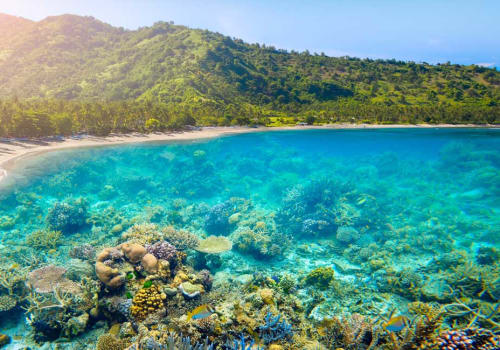
Finding the right cruise option allows solo travelers to focus entirely on epic vistas rather than extra fees. Navigating the logistics successfully opens the door to Indonesia’s most iconic coastal views.
“But surely I’d still have to pay a single supplement?
“Not necessarily,” I replied.
I was able to tell her, from my own experience, that on many Indonesian liveaboards, solo travelers can either pay a reduced supplement for a cabin, or opt for a twin-share with another solo guest of the same gender at no extra cost. The time that guests actually spend in their cabins is minimal; cabins are for sleeping, showering, and a quick change after a dive or before a village visit. Some companies even waive supplements entirely if the boat isn’t full and an empty cabin is available because they consider solo travelers to be an important part of their market. Furthermore, instead of paying separately for hotels, transport, meals, guides, ferries, excursions and island transfers, nearly everything is bundled into one floating package. Accommodation, food, activities, and transportation becomes part of the same journey.

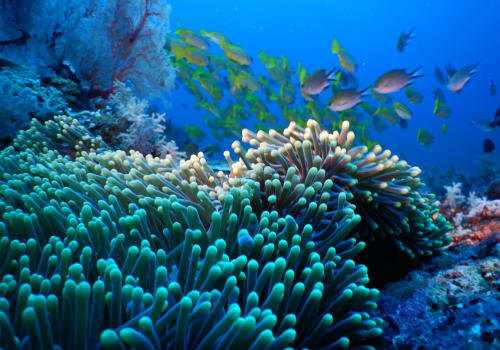
A streamlined logistics advantage lets you transition effortlessly from ship to shore. Explore delicate ecosystems like mangroves and shallow reefs up close with provided gear.
The Indonesian Archipelago is all about boats. Flights connect the hubs for sure, but you won’t see the magic of Komodo’s pink-sand bays, Raja Ampat’s limestone mazes, or Banda’s spice-perfumed islands unless you travel on the water. On a small liveaboard, all of the logistical difficulties vanish, you’re rarely alone unless you choose to be, and you’ll wonder why you ever tried to stitch Indonesia together with flights, ferries, and hope. Surprisingly, a 10-night small-ship cruise often costs less than piecing together the equivalent experiences on land and the time spent getting from one place to the next. On a liveaboard, the complexity fades into the background. The boat moves while you sleep, meals appear without planning, and excursions happen seamlessly. National park permits are handled for you, and instead of constantly figuring out how to reach the next island, you simply wake up there.

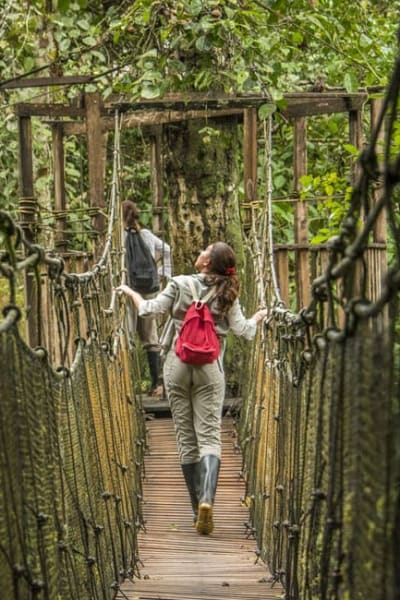
Shared adventures ashore build natural connections. Group treks through unique terrain make it easy to bond with fellow travelers, blending independent exploration with a built-in community.
Boats such as Samara I and Aliikai offer small group cruises, also known as shared or open trips, for up to 12 or 15 guests. These trips are all about making new friends, creating memories, and learning new things together, allowing you the opportunity to share a wonderful island-hopping experience, even as a solo traveler, complete with plenty of room onboard for you to find your own space if you want to.
Up to 20 people is small enough to feel intimate but large enough to create social variety. You naturally fall into conversation without pressure. There’s always someone to join for coffee at sunrise, but there’s also enough space to disappear quietly onto the upper deck with a book when you need solitude. A boat will dissolve social barriers in ways that hotels never do. The boat is small enough that one dining table holds everyone, yet big enough for conversations to diverge and merge. Everyone watches the same sunsets and everyone gets excited when dolphins appear alongside the bow. Shared experiences bring people together fast, and Indonesia’s nature and geography is so astonishing that it gives people a genuine reason to connect. You aren’t trapped making forced small talk in a generic resort lobby. At a resort, solo travelers can disappear into their rooms unnoticed. On a liveaboard, everyone gathers repeatedly throughout the day. You’re discussing manta rays over dinner, swapping stories about dragons on Komodo Island, comparing underwater photos after a dive in Raja Ampat, and watching flying foxes stream across the sky at dusk. The most common solo fear is social mismatch. “If I don’t click, I’m stuck on a boat.” But you don’t need to be best friends with everyone. Two or three easy connections will carry the trip. Indonesian boat crew are usually warm, witty, and curious. Learn their names. Ask about their islands. Indonesia has deep maritime roots and hospitality is communal.

Small-ship cruises unlock the hidden corners of Indonesia, navigating narrow channels to reach isolated islands and pristine shores that larger vessels simply cannot access.
Many of Indonesia’s greatest experiences happen in places inaccessible to mass tourism. Tiny reefs, hidden coves, remote villages and uninhabited islands. Small boats can anchor where larger vessels cannot. They adapt to weather, wildlife sightings, and local conditions dynamically, and because liveaboards attract naturally adventurous people, conversations tend to move beyond superficial travel chatter very quickly.
So, when people ask me whether Indonesia is good for solo travelers, I tell them to get on a small ship to enjoy a shared adventure with enough intimacy to foster connection and enough freedom to preserve independence. Indonesia will reveal itself not as a place developed for couples, but as a place where arriving alone might actually be the advantage.
While Rainforest Cruises aim to provide accurate and up-to-date information, we make no representations as to the accuracy or completeness of any information herein or found by following any link on this site. Rainforest Cruises cannot and will not accept responsibility for any omissions or inaccuracies, or for any consequences arising therefrom, including any losses, injuries, or damages resulting from the display or use of this information.